

TL;DR: Choosing where to take your engagement photos shouldn’t start with a price list. We built the Location Gallery so you can compare engagement session locations, hours, and pricing across Vegas, SF, LA, Seattle, and beyond — before ever emailing a photographer. It’s for engagement sessions only, not wedding-day coverage or venue planning.
A better way to compare engagement session locations
I don’t remember where I got the idea.
I remember the feeling.
It wasn’t from a photographer, and it wasn’t from a business book. It was some configurator on some website, years ago — I’ve long since forgotten which one. But the feeling never left, and the closest thing to it today is picking out a MacBook Pro on Apple’s website.
You pick the size. Then the chip — and the price moves. Then the memory. Then the storage. Then you sit there, genuinely asking yourself: is the bigger chip worth $500 to me? More memory, a few hundred more. More storage, more again. And the delivery date sits right there the whole time, updating with every choice.
Nothing is hidden and nothing is decided for you. You’re just weighing it up, quietly, at your own pace, watching the number change every time you change your mind. And here’s the part of that feeling that stayed with me:
You never have to ask anybody a single question.
No salesperson. No email. No “let me get back to you on pricing.” By the time you walk into the store, you already know exactly what you want and exactly what it costs.
That feeling sat in the back of my head for years, until one day I realized:
This is exactly what I’m not giving couples.
The question couples actually can’t answer
When someone reaches out about an engagement session, I used to do what most photographers do.
Send the packages.
Here’s what we offer. Here’s what’s included. Here’s the pricing. Let me know what you think.
And almost every time, the reply was some version of:
“…we’re not really sure yet.”
For a long time, I thought that meant they weren’t sure about me.
It doesn’t.
It means they’re not sure where.
A price list answers a question couples haven’t reached yet. Before anyone can think about hours, image counts, and package options, they have to answer something much bigger and much more personal:
Where do we want to be standing when this happens?
Vegas? San Francisco? Seattle? Somewhere with red rock and nobody around? Somewhere with a city behind us? Somewhere quiet, cinematic, and far from everyone?
Until that is settled, every package looks the same.
It’s a spec sheet for a MacBook Pro you haven’t picked yet.

A lot of sessions means a lot of conversations
For the last four years, I have photographed around 100 engagement sessions a year.
That is a lot.
It means I am photographing engagement sessions at least twice a week, and as someone who genuinely loves taking pictures, I do not say that as a complaint. I am deeply grateful that so many couples have trusted me with that season of their lives.
But to book 100 sessions, I usually had to talk with somewhere around 200 to 400 couples.
And that started to weigh on me.
Not because I dislike the conversations. Honestly, the whole business was built around listening to your story and telling that story to the world. I love learning where you are coming from, what matters to you, who the photos are for, and what kind of life chapter you are trying to remember.
That part is an honour.
But I also feel I owe it to every couple who hires me to keep growing — as a photographer, as a business, and as a person who can stay in this work for a long time. I want to keep photographing better. I want to travel a little more. I want to meet different kinds of clients in different places. I want Eugene Kim Photography to become stronger, not just busier.
And I think clients understand that more than we sometimes give them credit for.
Some of the brands I love — even when I am not a direct stakeholder — make me feel proud when they grow. When they do something thoughtful, when they improve, when they keep building, I feel happy for them.
That has happened with my own couples too.
Sometimes someone I photographed two years ago will reply to an Instagram story and say something like:
“I see that you’ve been busy. We are so happy for you. We cannot believe it’s already been two years since we worked with you. We actually mean to do another shoot with you, just to document our life. It’s just been busy, but we love how well you’re doing and how much you’ve grown. We see that you’re staying busy, and we’re just happy for you.”
I cannot tell you how much that means to me.
That kind of message made me realize something: growth does not have to make the experience less personal. If it is done carefully, growth can actually protect the experience.
That is why I knew I had to think outside the box.
Start with the place, not the price
The Location Gallery starts where the couple actually starts.
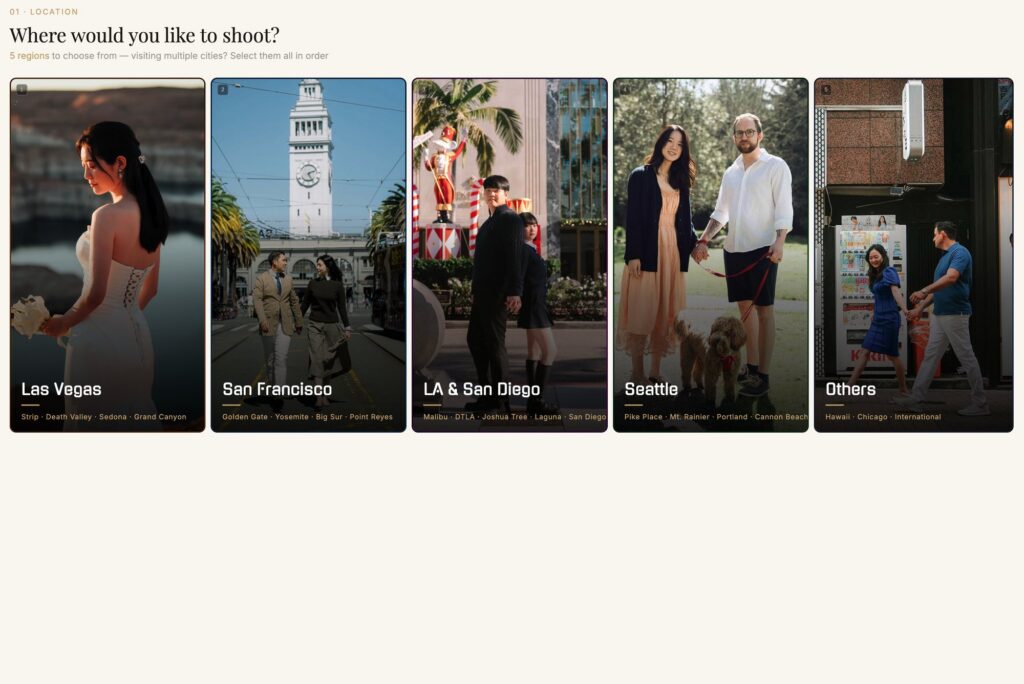
First: where are you going?
Not “pick a package.” Just — where in the world are you going to be? Vegas, San Francisco, Los Angeles, Seattle, somewhere further. Most couples can answer that because it is usually already half-decided by a trip, a season, or a family visit.
Then: what’s possible from there?
This is the real purpose of the Location Gallery.
It is not just calculating distance.
It is calculating what is possible.
Some photographers only offer sessions inside the city. Some mainly photograph national parks or remote landscapes. I do both.
But if I simply say “I do both,” that still leaves you with a lot of homework. You would have to read another article, compare locations, imagine the routes, and figure out whether a city session, a desert session, a national park session, or a mix of all of them is realistic for you.
The Location Gallery makes that visible.
Once you choose a region, it can show what actually works from that starting point — what is within reach, what a day realistically looks like, and what it costs to move between two places.
You can see that I am available in the city, in quieter rural areas, in national parks, and in places where those worlds overlap. You can mix those possibilities together and start to understand what kind of session you are actually drawn to.
Then: what kind of couple are you?
Adventurous — out in the landscape, hiking a little, chasing light in the desert.
Or city — architecture, streets, cafés, movement, somewhere you can walk to in nice shoes.
Or maybe you are both.
Maybe the session starts with clean city lines and ends somewhere wild. Maybe it starts in the desert and finishes with dinner clothes downtown. Maybe the best version of your session is not one category, but a combination you would not have known was possible from a static price list.
Three questions, and a wall of options becomes a short list you can actually think about.
These are guides, not rules
I want to say this clearly, because it matters:
The packages inside the Location Gallery are not fixed.
They are not a menu I am asking you to order from. They are a guide system — a way of showing what is realistic, what pairs well together, and roughly what it costs.
Almost every session we photograph ends up customized in some way.
The gallery exists so that when we do talk, we are customizing from a shared starting point instead of from a blank page.
The honest part
Here’s the part I’ll be straightforward about, because I would rather say it than pretend.
Understanding where a couple is coming from is genuinely one of the most important parts of my job.
Where are these photos going to live? Who are they for? Are they for the two of you, for your wedding website, for save-the-dates, or for parents in Korea who may not be able to be there?
I ask because the answers change everything about how I photograph.
But I cannot do that well for everybody who writes in if every conversation starts with the same twelve logistical questions.
If I spend every day answering things that really just need clear information — how much is this combination, how many hours is that, can we do these two places together — then I am not editing, not building, not traveling, and not growing as a photographer.
And after enough parallel conversations in a week, I start carrying too many details in my head at once.
That is not the version of me anyone should get.
I also know how it feels from the other side. Many couples apologize for asking questions. They send a message that starts with “sorry, one more thing —” and I hate that.
Nobody should feel like they are imposing for wanting to know what something costs, what is realistic, or whether the session they are imagining can actually happen.
So I built something that answers the repeated questions without removing the human part.
The Location Gallery is not meant to replace the conversation.
It is meant to improve the conversation.
The idea finally caught up with the technology
The idea for a configurator had been sitting in my head for a long time.
Honestly, it was there before COVID. I knew what I wanted the experience to feel like: choose something, watch the options change, understand the trade-offs, and feel more confident without waiting for a reply.
But for years, there was no realistic way for me to build that.
Now, because of AI tools, vibe coding, and all these new models, I can finally take something from my own thinking — my imagination, my process, my years of answering the same questions — and turn it into a real tool couples can use.
Building it has been so much fun.
It is still not perfect, but we are getting there: quicker, cleaner, more efficient, full of useful information, but still simple and intuitive to use.
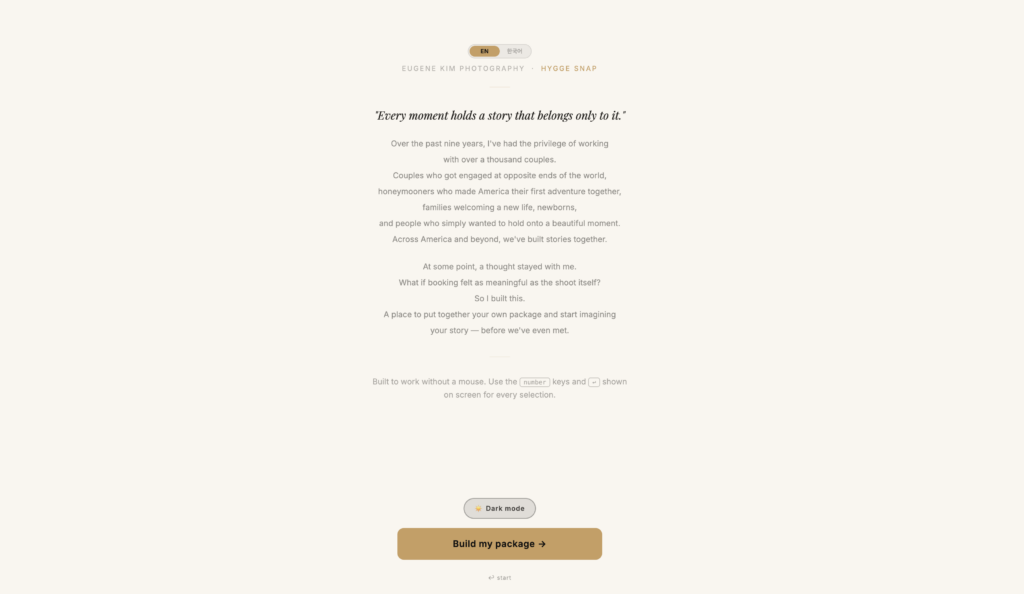
Even the little interaction details matter to me. We built in a Typeform-style keyboard flow so you can move through the gallery without overthinking it. You can press numbers, make selections, and play around with combinations instead of feeling like you are filling out a heavy form.
That is the feeling I wanted.
Not homework.
Exploration.
What the Location Gallery gives you
Inside the gallery, you can just play with it — the same way you’d play with that configurator.
Pick this location and that one. Watch what happens to the number of hours, the number of images, and the price. Change your mind. Try a different combination. Add a second city and see what it costs. Take it away again.
That is the bigger chip worth five hundred dollars? moment, except now the question is:
Is the second location worth the extra half-day?
Or:
Do we want the city, the landscape, or both?
Is it worth planning around a travel date?
Would this feel more like us if we made it slower, quieter, or more adventurous?
Those are questions only the two of you can answer.
You should get to answer them without someone waiting on the other end of an email.
You can sit there at eleven at night with your partner and work out what you actually want, together, with nobody watching and nobody waiting on a reply.
By the time we speak, you are not asking me what is possible.
You are telling me what feels right.
That is a better conversation for both of us.
Travel dates, promotions, and better timing
While I was building the Location Gallery, I realized I could put my own travel schedule into it — the dates I am already going to be in a region — along with whatever promotions are running.
That sounds like a business thing, and it is.
But it works in your favour more than mine.
If I am already going to be in San Francisco that week, your session can cost meaningfully less than flying me out for it separately. The gallery can steer you toward the dates when you get more for less, because those are the same dates that work for me.
Both sides win, and nobody has to negotiate.

What couples have said so far
Since launching the Location Gallery, two couples have already booked through it.
Both told me they had never seen anything like it.
They said it was fun to play with, easy to understand, and genuinely helpful before reaching out.
That matters to me because it tells me the tool is doing what I hoped it would do: making couples feel more confident before the conversation starts.
Not pressured.
Not pushed.
Just clearer.
This is version two
The Location Gallery is still early.
What you are using now is version two, and there is more coming.
The main thing I want to add is depth. Right now, the gallery has to stay clean and fast. It cannot turn into an essay.
But there is so much I would want to explain:
- What a hybrid documentary session actually is, and why photographing and filming at the same time changes what you end up with.
- Why sunrise in Death Valley is a completely different experience from sunset.
- What a Grand Circle multi-day tour really involves.
- How two locations that look close on a map can feel very different on an actual session day.
- Why a city session and a national park session ask for completely different rhythms, clothing, timing, and energy.
All of that belongs in writing, not inside a picker.
So the next version will link out — from a location straight into a full article about it, here on the blog and on our Naver blog in Korean.
Choose a place. Read the story behind it. Come back and decide.
Over time, I want the Location Gallery to become a place where you can find the answers before you even know what questions to ask.
That is the whole idea.
Not fewer choices.
Better ones, in the right order.

Try it
https://location-gallery.vercel.app
The Location Gallery works in English and Korean, on your phone and on desktop.
There is no form to fill in first and nothing to sign up for. Go and play with it.
Click around. Press the number keys. Try the city version, the landscape version, the version that feels a little too ambitious, and the version that feels easy.
And when you have found the combination that feels right — or if you get halfway through and want to talk it over with an actual human — I am here.
That is still my favourite part.


